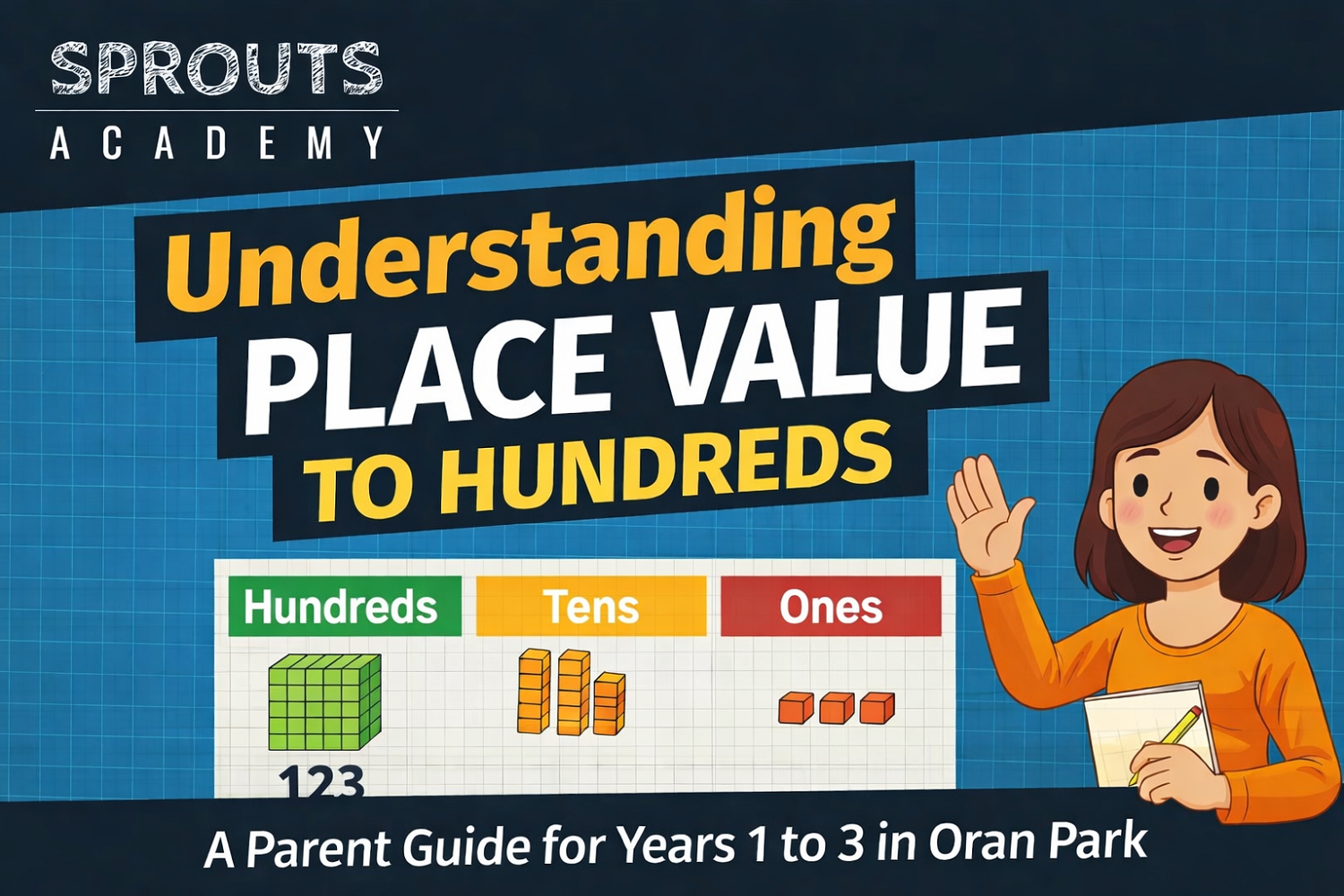
Place value errors like this are among the most common reasons students in Years 1 to 3 struggle with addition, subtraction, and number sense — and they are completely fixable with the right structured approach.
When a child writes 306 and reads it back as three hundred and sixty, they are not guessing. They have a specific gap in their understanding of what the zero in the tens column actually means.
At Sprouts Academy, we work with students across Oran Park NSW 2570 and Gregory Hills NSW 2557 to close exactly these kinds of gaps before they compound into bigger difficulties in Stage 2 and Stage 3 mathematics. This guide explains what place value to hundreds looks like in the NSW curriculum, what the most common errors are, and how structured tutoring builds genuine, independent number fluency.
What Is Place Value and Why Does It Matter?
Place value is the system that gives each digit in a number its meaning based on its position. In a two-digit number like 47, the 4 represents 4 tens (forty) and the 7 represents 7 ones (seven). In a three-digit number like 352, the 3 represents 3 hundreds (three hundred), the 5 represents 5 tens (fifty), and the 2 represents 2 ones (two).
Understanding this is not just a Year 1 concept that gets left behind. It underpins every calculation a student will do in primary school. A student who cannot reliably say what the digit 6 means in the number 164 will make consistent, predictable errors when adding or subtracting across tens. They will struggle to round numbers, estimate answers, or tell whether a result is reasonable. Place value is the foundation that everything else is built on.
Students who struggle with place value rarely struggle with effort. They struggle because the concept requires them to hold two ideas at the same time: the face value of a digit (the number you see) and the place value of that digit (what it is actually worth in context). This is a genuine cognitive challenge, and it responds well to systematic, visual instruction.
NSW Curriculum Outcomes: MA1-RWN-01 and MA2-RWN-01
The NSW Curriculum requires students to develop place value understanding progressively across Stage 1 and Stage 2.
Outcome MA1-RWN-01 (Stage 1, Years 1-2) requires students to apply place value to read, write, and order two-digit numbers. This includes understanding that a two-digit number is made up of tens and ones, partitioning numbers (for example, 73 = 70 + 3), and using this understanding to compare and order numbers.
Outcome MA2-RWN-01 (Stage 2, Years 3-4) extends this to three-digit and four-digit numbers. Students are required to read, write, and order numbers up to at least three digits, apply zero as a placeholder (understanding that 306 and 360 are different numbers), and use place value understanding to support mental and written calculation.
What Your Child Should Be Able to Do at Each Stage
By the end of Stage 1 (Year 2), a student should be able to:
- Read and write any two-digit number in words and numerals.
- Partition a two-digit number into tens and ones (for example, 85 = 80 + 5).
- Order a set of two-digit numbers from smallest to largest.
- Identify which digit is in the tens column and which is in the ones column.
By the end of early Stage 2 (Year 3), a student should be able to:
- Read and write any three-digit number in words and numerals.
- Correctly use zero as a placeholder (for example, knowing that 407 has no tens).
- Partition a three-digit number into hundreds, tens, and ones.
- Order and compare three-digit numbers using place value reasoning, not digit size.
The Most Common Place Value Mistakes Students Make
In our tutoring sessions across Oran Park and Gregory Hills, we see the same errors recurring across students at this stage. Naming them clearly is the first step to addressing them.
- Treating digits as independent numbers. A student who reads 247 as two, four, seven rather than two hundred and forty-seven does not yet have a feel for the number as a whole quantity.
- Ignoring zero. Students frequently write 30 as 3, or read 305 as thirty-five, because they do not yet understand that zero is holding a column that would otherwise collapse the number.
- Comparing digits instead of values. When asked which is larger, 89 or 91, some students say 89 because 9 is larger than 1. They are comparing individual digits rather than the full values.
- Inconsistent partitioning. A student might correctly write 342 = 300 + 40 + 2 in a worksheet exercise but then write 300 + 4 + 2 under pressure in a different context, revealing surface-level rather than deep understanding.
Worked Example 1: Reading and Writing a Three-Digit Number
Question
Write the number four hundred and seven in numerals. Then write the value of each digit.
Step-by-Step Solution
Step 1: Identify the hundreds digit.
Four hundred means 4 is in the hundreds column.
Hundreds column: 4
Step 2: Identify the tens digit.
The number says ‘and seven’ — there are no tens.
Zero holds the tens column as a placeholder.
Tens column: 0
Step 3: Identify the ones digit.
Seven is in the ones column.
Ones column: 7
Step 4: Write the numeral.
Hundreds | Tens | Ones
4 | 0 | 7 = 407
Step 5: Write the value of each digit.
4 is worth 400 (4 hundreds)
0 is worth 0 (no tens)
7 is worth 7 (7 ones)
Why This Step Matters
Step 1 and Step 3 are usually straightforward for students at this stage. Step 2 is where errors occur. When no tens are mentioned, many students simply skip the tens column and write 47 instead of 407. Writing zero explicitly in the tens column before writing the final numeral is the step that prevents this error. The placeholder zero must be treated as a deliberate action, not an afterthought.
This is the step we reinforce most in guided practice at Sprouts Academy. We ask the student to say out loud: there are no tens, so I write a zero in the tens column. Verbalising the step builds the habit faster than writing alone.
Worked Example 2: Ordering Three-Digit Numbers from Smallest to Largest
Question
Place these numbers in order from smallest to largest: 382, 328, 832, 238.
Step-by-Step Solution
Step 1: Look at the hundreds digit of each number first.
382 –> 3 hundreds
328 –> 3 hundreds
832 –> 8 hundreds
238 –> 2 hundreds
Step 2: Order by hundreds digit.
Smallest hundreds: 238 (2 hundreds)
Middle hundreds: 382 and 328 (both have 3 hundreds)
Largest hundreds: 832 (8 hundreds)
Step 3: For the two numbers with equal hundreds, compare the tens digit.
382 –> 8 tens
328 –> 2 tens
Since 2 tens is less than 8 tens, 328 comes before 382.
Step 4: Write the final order.
238, 328, 382, 832
Why This Step Matters
Step 1 establishes the rule: always compare the highest place value column first. This prevents the most common error, which is comparing digits at random or comparing the ones digits first because they appear last.
Step 3 models what to do when two numbers share the same hundreds digit — move to the tens column. This is the exact thinking a student needs to apply fluently in Stage 2 when numbers extend to four digits. Practicing it with three-digit numbers builds the pattern before the numbers get harder.
Behavioural Confidence Marker
Confidence in mathematics is not a feeling — it is a behaviour. Here is what the shift looks like when a student moves from confusion to genuine place value fluency.
Before Sprouts Academy, a student at this stage typically avoids number writing tasks, writes digits in the wrong columns, says “I don’t know” when asked which number is bigger, and relies on counting on fingers instead of using place value.
After 6 to 8 weeks of structured sessions, that same student picks up a worksheet and attempts the number independently, verbalises column positions out loud, correctly orders three-digit numbers without prompting, and notices and self-corrects when a zero placeholder is missing.
How the Sprouts Confidence Loop Model Builds Place Value Understanding
At Sprouts Academy, we do not move to the next concept until the current one is genuinely solid. Our five-step Sprouts Confidence Loop Model is applied to every place value session:
- Diagnose skill gap: We begin each new engagement with a short diagnostic to find exactly where the student’s understanding breaks down — two-digit partitioning, zero as placeholder, or ordering under pressure.
- Teach clearly: We use a physical place value chart alongside number expanders to make the columns visible and tactile. Every digit is given its column name before any numerals are written.
- Guided practice: The tutor works through ordering and writing tasks with the student, asking out loud questions at each step — what column is this digit in? What is this digit worth?
- Independent practice: The student completes a set of problems without tutor support. The tutor observes without correcting mid-task, and notes specific error patterns for the debrief.
- Retrieval and reinforcement: In every following session, two or three place value questions are included as a warm-up. This prevents the concept from fading between lessons and prepares students for NAPLAN and classroom assessments.
After 6 to 8 weeks of structured sessions, the progress our tutors observe in students from local schools including Oran Park Public School and Gregory Hills Public School is not just academic. The student who was erasing and re-erasing their number is now writing it in one go and explaining why.
Signs Your Child May Need Structured Support
Parents in Oran Park and Gregory Hills often contact Sprouts Academy after noticing one or more of the following patterns in their child’s schoolwork:
- Consistent confusion between the tens and hundreds columns when writing numbers from words.
- Writing three-digit numbers that are missing a zero placeholder — for example, writing 46 instead of 406.
- Inability to explain which of two three-digit numbers is larger when asked, even after getting the answer right on a worksheet.
- Losing marks on NAPLAN practice or classroom assessments on number ordering questions despite understanding basic counting.
- Homework avoidance or frustration specifically around number tasks, but not around other subject areas.
Each of these patterns points to a specific, identifiable gap. They are not signs of a student who is not capable — they are signs of a student who has not yet been taught the concept in a way that built genuine understanding, and who would benefit from the structured, diagnostic approach Sprouts Academy uses.
The Sprouts Academy Difference in Oran Park and Gregory Hills
Sprouts Academy offers in-home one-to-one tutoring and small group sessions capped at 8 students for families across Oran Park NSW 2570 and Gregory Hills NSW 2557. Every lesson is NSW curriculum-aligned, structured around a specific outcome, and followed up with a parent communication that covers what was taught, what gap was identified, what progress was observed, and what the focus for next lesson will be.
Parents do not have to wonder whether the lesson was useful. They receive a clear, specific account of what happened. That visibility is what makes structured tutoring different from a general homework session, and it is what allows parents to see the Confidence Loop working in real time.
If your child is in Years 1 to 3 and showing any of the signs described in this guide, the first step is a diagnostic assessment. Contact us via the Sprouts Academy website to discuss availability and arrange a session.
Frequently Asked Questions
What year level is place value to hundreds taught in NSW schools?
Place value to hundreds is introduced in Stage 1 (Year 2) under outcome MA1-RWN-01 and extended to three-digit numbers in early Stage 2 (Year 3) under MA2-RWN-01. Students need to be fluent with these concepts before moving to four-digit numbers later in Stage 2.
Why does my child keep writing 47 instead of 407 when I say four hundred and seven?
This is a zero placeholder error. When a number has no tens, many students simply skip the tens column rather than writing a zero to hold it. The fix is to explicitly teach that zero is an active digit performing a job, not an absence. In our sessions, we ask students to name every column out loud before writing the numeral.
My child can count to 1000 but cannot order three-digit numbers. Is that normal?
Yes, this is common. Counting to 1000 relies on sequential memory. Ordering three-digit numbers requires understanding the value structure of each digit. These are different skills. A student can have one without the other, and both need to be taught directly.
How long does it take for a student to become confident with place value to hundreds?
In our experience working with students from schools like St Justin’s Catholic Primary School and Gregory Hills Public School, most students show clear improvement within 6 to 8 weeks of structured weekly sessions, provided the diagnostic has correctly identified the specific gap and lessons are targeted to that gap rather than the concept generally.
Is place value important for NAPLAN?
Yes. Place value underpins a significant portion of the NAPLAN Year 3 numeracy assessment, including number ordering, addition and subtraction, and basic measurement. Students who are not fluent with place value to hundreds will drop marks across multiple question types, not just number questions.
How is Sprouts Academy tutoring different from school instruction?
School instruction covers the full class with a shared program. Sprouts Academy identifies the specific gap for each individual student through a diagnostic assessment and builds a lesson sequence around that specific gap. Every session is one outcome at a time, with guided and independent practice built in and a parent communication after each lesson.
Do you offer in-home tutoring for place value in Oran Park?
Yes. We offer in-home one-to-one tutoring across Oran Park NSW 2570 and Gregory Hills NSW 2557. Sessions can also be offered in small groups of up to 8 students. Contact us through the website to discuss availability.
What if my child knows place value but still makes errors under test conditions?
Test-condition errors usually mean the concept is understood at a surface level but not yet fluent enough to apply under pressure. Our Retrieval and Reinforcement step — the fifth stage of the Sprouts Confidence Loop — is designed specifically for this. We revisit the concept in every session as a timed warm-up until it becomes automatic.